Mormon Coffee

It's forbidden, but it's good!

The official blog site of Mormonism Research Ministry

Wednesday, June 06, 2007

Joseph Smith on Humility, Innocence and Truth


by Sharon

One hundred and sixty-three years ago tomorrow (June 7, 1844) the one and only issue of The Nauvoo Expositor was published in Nauvoo, Illinois. The newspaper was intended to be the voice of the Reformed Mormon Church, a dissident religious group led by former counselor in the LDS First Presidency, William Law.

The members of the Reformed Mormon Church were deeply opposed to Joseph Smith's polygamy. The preamble of The Nauvoo Expositor explained,
Many of us have sought a reformation in the [Mormon] church, without a public exposition of the enormities of crimes practiced by its leaders, thinking that if they would harken to council, and show fruit meet for repentance, it would be as acceptable with God, as though they were exposed to public gaze... But our petitions were treated with contempt, and in many cases the petitioner spurned from their presence, and particularly by Joseph [Smith], who would state that if he had sinned, and was guilty of any charges we would charge him with, he would not make acknowledgment, but would rather be damned; for it would detract from his dignity, and would consequently prove the ruin and overthrow of the Church.

We would ask him on the other hand, if the overthrow of the Church was not inevitable, to which he often replied, that we would all go to Hell together, and convert it into a Heaven, by casting the Devil out; and says he, Hell is by no means the place this world of fools suppose it to be, but on the contrary it is quite an agreeable place, to which we would now reply he can enjoy it if he is determined not to desist from his evil ways, but as for us, we will serve the Lord our God! (as quoted in Hallwas and Launius, Cultures in Conflict, 143-144)

The sermon in which Joseph Smith spoke of converting Hell into a Heaven was given in July of 1843 and is recorded in History of the Church 5:517. The other concerns voiced in The Nauvoo Expositor preamble can be better understood in the context provided by a speech Joseph delivered to the Saints just two weeks before the newspaper was published. On May 26, 1844 the Prophet said,
The Lord has constituted me so curiously that I glory in persecution. I am not nearly so humble as if I were not persecuted... If they want a beardless boy to whip all the world, I will get on the top of a mountain and crow like a rooster: I shall always beat them. When facts are proved, truth and innocence will prevail at last...

Come on! ye prosecutors! ye false swearers! All hell, boil over! Ye burning mountains, roll down your lava! for I will come out on the top at last. I have more to boast of than ever any man had. I am the only man that has ever been able to keep a whole church together since the days of Adam. A large majority of the whole have stood by me. Neither Paul, John, Peter, nor Jesus ever did it. I boast that no man ever did such a work as I. The followers of Jesus ran away from Him; but the Latter-day Saints never ran away from me yet... How I do love to hear the wolves howl! When they can get rid of me, the devil will also go...

A man has asked me whether the commandment was given that a man may have seven wives; and now the new prophet [William Law] has charged me with adultery...

What a thing it is for a man to be accused of committing adultery, and having seven wives, when I can only find one.

I am the same man, and as innocent as I was fourteen years ago; and I can prove them all perjurers. (History of the Church 408-412)

At the time Joseph Smith gave this speech there were 34 women and girls in Nauvoo who were wives of the Prophet.

Joseph said proven facts would allow truth and innocence to prevail; yet the publishers of The Nauvoo Expositor are defamed to this day, while Joseph Smith is lauded in song: "Great is his glory...Faithful and true, he will enter his kingdom, crowned in the midst of the prophets of old." (Praise to the Man, LDS Hymn 326)

Labels: ,

Monday, June 04, 2007

The White Horse Prophecy Rides Again


by Sharon

"Romney candidacy has resurrected last days prophecy of Mormon saving the Constitution," reads a headline today in The Salt Lake Tribune. The article, written by journalist Thomas Burr, discusses the so-called White Horse Prophecy which was purportedly received by Joseph Smith in 1843. The article states,
It's Mormon lore, a story passed along by some old-timers about the importance of their faith and their country.

In the latter days, the story goes, the U.S. Constitution will hang by a thread and a Mormon will ride in on a metaphorical white horse to save it. The Church of Jesus Christ of Latter-day Saints says it does not accept the legend -- commonly referred to as the "White Horse Prophecy" -- as doctrine. ...

The disputed prophecy was recorded in a diary entry of a Mormon who had heard the tale from two men who were with Joseph Smith in Nauvoo, Ill. when he supposedly declared the prophecy.

"You will see the Constitution of the United States almost destroyed," the diary entry quotes Smith as saying. "It will hang like a thread as fine as a silk fiber."

Not only will the Mormons save the Constitution, under the prediction, but the prophecy goes further, insinuating that Mormons will control the government.

"Power will be given to the White Horse to rebuke the nations afar off, and you obey it, for the laws go forth from Zion," the prophecy says.

In 1918 sixth LDS President Joseph F. Smith made certain Latter-day Saints understood the White Horse Prophecy was bogus. In that October's General Conference President Smith said the prophecy was "never spoken by the prophet" in the way people claim, and that, "It is simply false; that is all there is to it."

The White Horse Prophecy is generally ignored or forgotten, but it seems to come to the forefront when a Mormon becomes a candidate for the U.S. presidency. It came up in 1968 when George Romney was running for president, in 2000 when Orin Hatch was running for president, and now, while Mitt Romney is campaigning. The Salt Lake Tribune reports that Mr. Romney does not believe in the White Horse Prophecy.

In the article, Journalist Thomas Burr quotes George Cobabe, a man who researched the White Horse Prophecy for the LDS apologetics group FAIR. Mr. Cobabe said,
"I don't think the White Horse Prophecy is fair to bring up at all. It's been rejected by every church leader that has talked about it. It has nothing to do with anything."

While I agree with Mr. Cobabe that the White Horse Prophecy is not germane to Mitt Romney's white house bid, I don't think it's accurate to say that the prophecy "has been rejected by every church leader that has talked about it." Brigham Young seemed to believe the prophecy was true. In 1855 he said,
"...and when the Constitution of the United States hangs, as it were, upon a single thread, they will have to call for the 'Mormon' Elders to save it from utter destruction; and they will step forth and do it." (Journal of Discourses 2:182; also Discourses of Brigham Young, 361)

Thirteen years later, in 1868, Brigham Young again spoke in support of the White Horse Prophecy:
"How long will it be before the words of the prophet Joseph will be fulfilled? He said if the Constitution of the United States were saved at all it must be done by this people. It will not be many years before these words come to pass." (Journal of Discourses 12:204; also Discourses of Brigham Young, 360)

Though the White Horse Prophecy has no place in modern-day Mormonism, there was a time when the prophet, seer and revelator of the LDS Church believed it -- and preached it.

Labels: ,

Friday, May 18, 2007

Joseph Smith for President

by Sharon

There's another movie about Mormonism in the works. A French magazine reports,
A Mormon President, the first documentary film to explore the Mormon Prophet, Joseph Smith's campaign for the US Presidency and its implications for the candidacy of another Mormon, Mitt Romney, has begun production and is slated for a fall 2007 release.

Filmmaker Adam Christing grew up in the Community of Christ Church (formerly known as the Reorganized Church of Jesus Christ of Latter Day Saints), studied theology at Biola University, and is currently a member of the Mormon History Association. Mr. Christing spoke about A Mormon President:
This film may be upsetting to "anti-Mormons" because it shows what a generous man and visionary leader Joseph Smith was. It may shock some Mormons because it documents the untold story of Smith's secret marriages to more than 30 women and his campaign for President which led directly to his murder in 1844...

This is a serious piece, but it will be very engaging. I've been fascinated by Joseph Smith's story ever since I was a kid. Here's a man who started a religion, built a city bigger than Chicago in its day, became a Master Mason, and ran for President. He packed more adventure into 3 years than most people experience in a lifetime.

This sounds like it will be an interesting film, as the history of Joseph Smith's politics is very intriguing. For instance, many people don't know that Smith was secretly crowned king on April 11, 1844. His campaign for president of the United States was much more complicated than most would imagine.

About Smith's ordination as king, former LDS historian D. Michael Quinn wrote:
William Marks...stated that the [LDS] Council of Fifty performed an ordinance "in which Joseph suffered himself to be ordained a king, to reign over the house of Israel forever."

Some have been uncomfortable with the assertion that Smith became a king. They have claimed that Marks and other critics either confused or misrepresented Smith's reception of the strictly religious ceremony of the second anointing as "king and priest."...

In fact a later revelation to the Council of Fifty affirmed that God called Smith "to be a Prophet, Seer and Revelator to my Church and Kingdom; and to be a King and Ruler over Israel." (The Mormon Hierarchy, Origins of Power, 124)

Joseph Smith told the press that he wanted to create a "Theo-democracy." Quinn wrote,
The phrase was catchy, but what precisely did he mean by "Theo-democracy"? In the spring of 1844 Smith gave the public only an indistinct foreshadowing of the new world order he was formulating in his secret meetings with the Council of Fifty. (125)

I'm not sure how a monarchy fits with a theocracy, a theo-democracy, or a republic. But the subject of the film A Mormon President holds the promise of being fascinating indeed.

Labels:

Monday, January 22, 2007

Choose Life, Choose Truth

by Sharon

Today, January 22nd, 2007, marks the 34th anniversary of the legalization of abortion in the United States. Forty million unborn babies have been legally killed in this nation since that tragic ruling.

My father is in favor of legalized abortion, citing the gruesome stories of illegal back-alley abortions he heard about as a young man. I wasn't there, of course, but I've also heard plenty of horror stories about abortions that pre-dated Roe vs. Wade. Nevertheless, I'm compelled to place a higher value on pre-born life than my father does. Perhaps it's because we don't share a common faith in the Giver and Creator of life, the God who bestows value on all life.

Even so, there's an important argument that can be made for the sanctity of human life that doesn't rely on faith issues. But my dad won't talk about it. I think there are a lot of people who don't want to talk about it. Though it's legal, the topic is packed with emotion and conviction -- as it should be, since lives are at stake.

The LDS Church position on abortion is this:
If a child is conceived by those who break the law of chastity, they may be tempted to commit another abominable sin: abortion. There is seldom any excuse for abortion. The only exceptions are when --
    1. Pregnancy has resulted from incest or rape.
    2. The life or health of the woman is in jeopardy in the opinion of competent medical authority; or
    3. The fetus is known, by competent medial authority, to have severe defects that will not allow the baby to survive beyond birth.
Even in those cases the couple should consider an abortion only after consulting with each other and their bishop or branch president and receiving divine confirmation through prayer. (Gospel Principles, 1992 edition, 251,)

This has not always been so. The previous edition of Gospel Principles (to the one quoted above) said,
If a child is conceived by those who break the law of chastity, they may be tempted to commit another abominable sin -- abortion. There is no excuse for abortion unless the life of the mother is seriously threatened. (1988 edition, 214)

Going back even further, Sarah Pratt, wife of early LDS Apostle Orson Pratt, related a story from when she lived in the Mormon community of Nauvoo, Illinois:
"One day they came both, Joseph [Smith] and [John C.] Bennett, on horseback to my house. Bennett dismounted, Joseph remained outside. Bennett wanted me to return to him a book I had borrowed from him. It was a so-called doctor-book. I had a rapidly growing little family and wanted to inform myself about certain matters in regard to babies, etc., -- this explains my borrowing that book. While giving Bennett his book, I observed that he held something in the left sleeve of his coat. Bennett smiled and said: 'Oh, a little job for Joseph; one of his women is in trouble.' Saying this. [sic] he took the thing out of his left sleeve. It was a pretty long instrument of a kind I had never seen before. It seemed to be of steel and was crooked at one end. I heard afterwards that the operation had been performed; that the woman was very sick, and that Joseph was very much afraid that she might die, but she recovered.

"Bennett was the most intimate friend of Joseph for a time. He boarded with the prophet. He told me once that Joseph had been talking with him about his troubles with Emma, his wife. 'He asked me,' said Bennett, smilingly, 'what he should do to get out of the trouble ?' I said, 'This is very simple. GET A REVELATION that polygamy is right, and all your troubles will be at an end.'" (Dr. W. Wyl, Mormon Portraits: Joseph Smith The Prophet -- His Family and His Friends, 61-62)

I don't mean to suggest that Dr. Bennett's abortions were in any way sanctioned by the LDS Church. Dr. Bennett was a scoundrel by all accounts. Consider the sworn testimony of Joseph Smith's brother, Hyrum:
On the seventeenth day of May, 1842, having been made acquainted with some of the conduct of John C. Bennett, which was given in testimony, under oath…by several females who testified that John C. Bennett endeavored to seduce them, and accomplished his designs by saying it was right; that it was one of the mysteries of God, which was to be revealed when the people was strong enough in faith to bear such mysteries -- that it was perfectly right to have illicit intercourse with females, providing no one knew it but themselves, vehemently trying them from day to day, to yield to his passions, bringing witnesses of his own clan to testify that there were such revelations and such commandments, and that they were of God; also stating that he would be responsible for their sins, if there were any, and that he would give them medicine to produce abortions, provided they should become pregnant." (History of the Church, 5:71)

According to LDS authors Linda King Newell and Valeen Tippets Avery, if the women he approached were reluctant to accept Dr. Bennett's proposals, he would tell them he came with Joseph Smith's approval (Mormon Enigma, 111). There exists contradictory testimony from faithful Mormons, and from Bennett himself, that Smith's name was never invoked during these encounters. Whatever the truth of the matter, Hyrum Smith's testimony indicates that Dr. Bennett "accomplished his designs" with at least some of the women he approached (see also fawn M. Brodie, No Man Knows My History, 311). This raises a question in my mind.

Regardless of the level of responsibility Joseph Smith may have had in any of this -- whatever the official position of the LDS Church may have been -- what sort of society was it that proved to be fertile ground for Dr. Bennett's illicit proposals and his subsequent performance of abortions? What made these women vulnerable to his claims of revelations and commandments if they were contradictory to Church teachings? Perhaps this is where Joseph Smith becomes culpable. I'm uncertain whether he ever taught this principle publicly, or how often he may have taught it privately, but it's well known that in trying to convince Nancy Rigdon to become one of his plural wives, Joseph taught her:
"Happiness is the object and design of our existence; and will be the end thereof, if we pursue the path that leads to it; and this path is virtue, uprightness, faithfulness, holiness, and keeping all the commandments of God. …That which is wrong under one circumstance, may be, and often is, right under another. …Whatever God requires is right, no matter what it is, although we may not see the reason thereof till long after the events transpire." (see Mormon Enigma, 111, including footnote)

This teaching -- in the context of secretive, illegal polygamous marriage -- opens the door wide for credulity and confusion. I wonder how many unborn babies have died because of it.

Labels: , ,

Friday, September 22, 2006

Mormon Circles

by Sharon

According to the LDS history web site, on this day (September 22nd) in 1827 Joseph Smith "received the golden plates from the angel Moroni on the hill where they were buried." Eyewitnesses reported that Joseph took the gold plates home and began translating them with the help of a seer stone -- that is, a stone Joseph placed in a hat and gazed at. When English words appeared on the stone, Joseph recited them to a scribe -- and the Book of Mormon was born. (see David Whitmer, An Address to All Believers in Christ, page 12; see also A Comprehensive History of the Church of Jesus Christ of Latter-Day Saints, 1:129)

But years before the gold plates were discovered Joseph Smith used that same seer stone to find buried treasure for people who paid him for the service. In 1826 Joseph was brought before a justice to answer the charge that he was an imposter and was bilking people out of their money. (see Marquardt and Walters, Inventing Mormonism, pages 63-77) During the court proceedings Josiah Stowell, a man who had employed Joseph to find buried treasure, gave testimony.

I came across an interesting recounting of Mr. Stowell's testimony written by Abram W. Benton, a non-Mormon who lived in the area where the pre-trial took place. Mr. Benton's account was written in 1831 as a letter to the editors of the Evangelical Magazine and Gospel Advocate. The account is reprinted in Dan Vogel's Early Mormon Documents, volume 4:
Josiah Stowell, a Mormonite, being sworn, testified that he positively knew that said Smith never lied to, or deceived him, and did not believe he ever tried to deceive anybody else. The following questions were then asked him, to which he made the replies annexed.

Did Smith ever tell you there was money hid in a certain place which he mentioned? Yes. Did he tell you, you could find it by digging? Yes. Did you dig? Yes. Did you find any money? No. Did he not lie to you then, and deceive you? No! the money was there, but we did not get quite to it! How do you know it was there? Smith said it was! (pages 97-98)

Mr. Stowell's gullibility and circular reasoning is easy to see in his testimony. When I read it, it made me laugh. But the fact that many Mormons use this same sort of circular reasoning in determining spiritual truth is no laughing matter.

Early LDS Apostle Anthon H. Lund said,
Joseph Smith was a prophet of God. His teachings prove that what he taught was divinely inspired. (Conference Report 1899, October 13)

What did Mr. Lund mean? We can rephrase his statement like this:
Joseph Smith's teachings were divinely inspired; therefore, he was a prophet of God. And because he was a prophet of God, we know his teachings were divinely inspired.

Does this sound a bit like Josiah Stowell?

In the April 2005 General Conference of the LDS Church we find these statements:
  • We do not have to defend the Prophet Joseph Smith. The Book of Mormon defends him for us. (Boyd K. Packer, Ensign 5/2005, page 9)

  • [The Book of Mormon] is a tangible thing that can be handled, that can be read, that can be tested. It carries within its covers a promise of its divine origin. (Gordon B. Hinckley, Ensign 5/2005, page 82)

  • And upon the validity and truth of [Joseph's First] vision rests the validity of The Church of Jesus Christ of Latter-day Saints. (Gordon B. Hinckley, Ensign 5/2005, page 81)

So Joseph Smith produced the Book of Mormon; and the Book of Mormon says of itself that it is divinely inspired; and we can believe that it is divinely inspired because Joseph Smith, who produced the Book of Mormon, had an encounter with God the Father and Jesus Christ; and we know Joseph had this encounter because he said so and a true prophet of God would not lie; and we know he's a true prophet of God because he produced the Book of Mormon; and the Book of Mormon says it's divinely inspired; and since the Book of Mormon is divinely inspired Joseph must be a true prophet because a false prophet could not produce a truly divine book; after all, God appeared to Joseph in the woods and called him to be a prophet…

I get dizzy thinking about it.

If you are a praying person, please pray with me for all those lost in "spiritual" circular reasoning, that God would grant them eyes to see and a reasoning mind to understand.

Labels: , ,

Wednesday, May 03, 2006

Joseph Smith: The Prophet of the Restoration


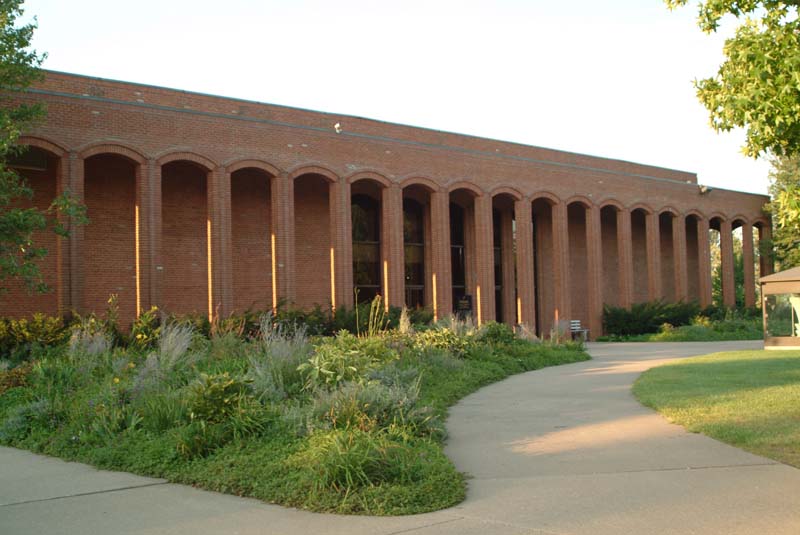
I've spent the last 4 days in Nauvoo, Illinois, the historic town used by the Mormon Church for faith-promotion and proselytizing. On Sunday, at the LDS Visitors Center (pictured at left), a friend and I viewed the movie, Joseph Smith: The Prophet of the Restoration. Produced as part of last year's celebration of the 200th anniversary of Joseph Smith's birth, this hour-long film is meant to depict the life and mission of Joseph Smith, the founder of The Church of Jesus Christ of Latter-day Saints.

As with all films produced by the Mormon Church, this one relies on manipulation of the viewers' emotions at the expense of accurate history. I expected this; but I was surprised -- and deeply offended -- by the blatant near-deification of Joseph Smith. Though this comment may seem severe, it does not even begin to convey the blasphemous nature of the film's portrayal of Joseph Smith's life. Let me explain.

Near the beginning of the movie, during the scene of Joseph Smith's First Vision, my friend leaned over to me and said, "Does this remind you of The Passion of the Christ?" And indeed it did. Joseph was portrayed in the Sacred Grove in torment as he prayed for wisdom. Nearly prostrate on the ground, he trembled and he sweat and he agonized as evil forces swirled around him. The scene immediately brought Christ's struggle in the Garden of Gethsemane to mind.

As the film continued we were struck time and again by the way it portrayed Joseph's life in seeming parallel with the life of Christ. It was almost as if the script writers had taken the story of Jesus and mapped Joseph's life onto it. Though the details and sequence of events differed, in discussing it after the film we recalled these corresponding scenes between this portrayal of Joseph's life and the life of Christ (listed here in no particular order):
  • The Garden of Gethsemane
  • Jesus crying, "My God, my God, why have you forsaken me?"
  • Scourging and mocking at the hands of soldiers
  • Judas' betrayal
  • Jesus' arrest
  • Peter's denial
  • Pilate's declaration, "This man is innocent."
  • Jesus washing the disciples' feet
  • Healing the sick
  • Raising Jairus' daughter to life

Throughout the entire film Joseph was abused and mistreated continually; he received this treatment for no reason at all. He was portrayed as being wholly innocent and righteous in all his ways. In the words of an LDS woman, the Prophet of the Restoration was depicted as being perfectly and unreservedly "Christlike."

After the film a Mormon missionary asked me if I liked it. When I told her I had been offended and thought the film did a grave disservice to my Lord and Savior, she replied, "I'm sorry, but it's history."

Of course, it's not accurate history, but that's not the point I'm making here. To me, the film sought to elevate Joseph Smith to the level of someone worthy -- not just of reverence -- but of worship. In portraying the story of Jesus Christ in the person of Joseph Smith the film crossed the line from propaganda to blasphemy.

My friend believes the film reveals that within Mormonism there is no need for Jesus; Joseph is enough. As it happened, we later spoke with another LDS missionary and my friend asked, "In this church, if you have a testimony of Joseph Smith, do you need a testimony of Jesus Christ?" The missionary and his wife both answered no; that a testimony of Joseph and a testimony of Jesus are "one and the same." As we toured the historic LDS sites on Sunday, at each place we stopped and listened to the scripted tours, we were treated to the missionaries' "testimony of Joseph." Not once did a Mormon missionary share a testimony of Jesus.

Now that I've had a few days' distance from my encounter with Joseph Smith: The Prophet of the Restoration my indignation has settled into a deep sorrow over the spiritual state of the Mormon people. They have been so conditioned that they cannot see a significant difference between Joseph Smith and Jesus Christ. They watch The Prophet of the Restoration and dab tears from their eyes -- tears shed in gratitude for what the Prophet has done for them.

As I walked around Nauvoo and talked to the Mormon missionaries there I was saddened by their apparent willingness to sacrifice Christ's offer of reconciliation with God in Him, in favor of maintaining their own love of Church and devotion to Joseph Smith. I thought of Christ's words, "O Jerusalem, Jerusalem,…How often I wanted to gather your children together, as a hen gathers her chicks under her wings, but you were not willing!" (Matthew 23:37).

Yet even now Jesus stands at the door and knocks. If anyone hears His voice and opens the door, He "will come in to him" (Revelation 3:30). May God, in His mercy, give them ears to hear.

Labels:

Tuesday, January 17, 2006

Worship of Joseph Smith?

Reading the December 31, 2005 issue of Church News I came across this:
"As Latter-day Saints we no more worship Joseph Smith than we do Peter or any of the other ancient apostles. Peter, in fact, is an apt comparison. Both Joseph and Peter fearlessly obeyed the Master in conveying His gospel to every nation, kindred, tongue and people. Both men dedicated their lives to the work of the Kingdom, ultimately suffering a martyr's death in the cause of Christ. To both men we give our honor, respect, reverence and love—but not our worship." (p. 16)

This topic of whether or not Latter-day Saints worship Joseph Smith interests me. I've tried to figure out why people think Mormons worship Joseph. The fact that many do is evidenced by the constant denials coming from Mormons and the LDS Church. I suppose it could be rumor, but rumors usually die out in the face of reality. Mormonism gets plenty of good press which should put a stop to unfounded rumors. That leaves me thinking that perhaps the rumors won't die because there is something within Mormonism that keeps them alive.

So I asked the question on my web site, "In practical terms, how does LDS reverence for the Prophet Joseph Smith differ from LDS worship of Jesus Christ?" I had hoped to get some definitive answers from Latter-day Saints pointing out something unique in their worship of Christ that is not found in their behavior and feelings toward Joseph; for I am not aware of any differences.

By that I mean that Mormons sing songs about both Joseph and Jesus. They celebrate the births of both. They commemorate the deaths of both. They display statues of both. They testify of both, etc. So how is the general public to know the difference between how Mormons honor Joseph but worship Jesus?

My web question didn't generate any responses of substance. Several non-Mormons and ex-Mormons wrote that Latter-day Saints do indeed worship Joseph Smith. The Mormons who responded to the question merely asserted that they don't.

The comment from Church News caught my attention because of the comparison between Joseph and the Apostle Peter. If, as is implied, Latter-day Saints reverence both Joseph and Peter in the same way, then I would expect to find LDS songs, statues and celebrations in Peter's honor just as I find in honor of Joseph.

But they are not there.

In fact, I've visited many LDS sites and I can't remember seeing even one statue or monument depicting a biblical prophet or apostle—unless it also included Joseph Smith.

Of course, the mere fact of the display of a statue or monument does not indicate worship given. Consider how many LDS monuments there are to the Mormon pioneers, yet no one (or hardly anyone) accuses Mormons of worshiping these people. Consider the extensive statuary of the Catholic Church… Well, maybe that's not such a good example.

At any rate, I think the rumor that Mormons worship Joseph Smith persists because there is fuel for the fire. LDS veneration of Joseph may be misunderstood (as Mormons say), but surely the mistake is an honest one and wholly understandable.

I'm not sure which side of the debate I come down on. Perhaps the truth of the matter lies in the way Latter-day Saints define the word "worship." Or, as one Mormon responder to my web question implied, the difference lies in the one to whom the honor is given: If it's given to man, it is reverence; if given to deity, it's worship. Whatever the case, as Latter-day Saints continue to interact with non-Mormons in sharing their feelings about Joseph Smith—to borrow the words of Ricky Ricardo—"They got a lotta 'splainin' to do."

Labels:

Tuesday, January 10, 2006

Brigham Young Testifies of Joseph Smith—and Then Some

I just received my December 31st issue of Church News. This issue is pretty much dedicated to "Remembering Joseph Smith." The first article (which is all I've read so far) is titled Prophets Testify of Joseph Smith. It consists of short excerpts from the sermons and talks of Latter-day prophets. Each of the 14 prophets since Joseph Smith are represented, and each one had something to say about Joseph.

The first quote in the article is from Journal of Discourses, volume 5, page 332, "Observations by President Brigham Young, made in the Bowery, Wednesday Afternoon, October 7, 1857." I thought it might be interesting to see Brigham's comment about Joseph's mission in its context, so I looked it up.

I found that Brigham made some rather interesting remarks in that sermon. On the two pages surrounding the portion quoted in Church News (pages 331 and 332) Brigham noted the following:

Brigham desired to do the work of the kingdom so it would be "right and acceptable" to Joseph when Joseph comes again

The terms "United States" and "united hell" were synonymous as the government was then conducted

The God the Methodists worshiped was the "Mormon's Devil"

After passing Joseph Smith, Peter, the Apostles, and Abraham on the way to the Celestial kingdom people will be "very glad to see the white locks of Father Adam." Brigham then quoted John 17:3, "This is eternal life, to know thee, the only true God, and Jesus Christ whom thou hast sent."

Brigham was an Apostle of Joseph Smith

All the priests contemporary to Joseph's day were "as blind as Egyptian darkness" and knew nothing correct about heaven, hell, God, angels, or devils

Faithful Mormons, though 60 or 70 years old, look young and handsome; but if they apostatize, "they will become gray-haired, wrinkled, and black, just like the Devil."

Any comments?

Labels: ,