Mormon Coffee

It's forbidden, but it's good!

The official blog site of Mormonism Research Ministry

Wednesday, April 25, 2007

The Miracle of Satanic Suckerpunches?

by Aaron

It's been said that one man's trash is another man's treasure. In this case, one man's miracle is another man's "satanic sukerpunch." Both men are LDS Apostles, designated as prophets, seers and revelators in the Mormon Church. Here's what they said:

Spencer W. Kimball:
"Your Heavenly Father has promised forgiveness upon total repentance and meeting all the requirements, but that forgiveness is not granted merely for the asking. There must be works--many works--and an all-out, total surrender, with a great humility and 'a broken heart and a contrite spirit.'

"It depends upon you whether or not you are forgiven, and when. It could be weeks, it could be years, it could be centuries before that happy day when you have the positive assurance that the Lord has forgiven you. That depends on your humility your sincerity, your works, your attitudes." (The Miracle of Forgiveness, 324-325)

Jeffrey R. Holland:
"You can change anything you want to change, and you can do it very fast. Another satanic suckerpunch is that it takes years and years and eons of eternity to repent. That's just not true. It takes exactly as long to repent as it takes to say, 'I'll change'--and mean it. Of course there will be problems to work out and restitutions to make. You may well spend--indeed, you had better spend--the rest of your life proving your repentance by its permanence. But change, growth, renewal, and repentance can come for you as instantaneously as they did for Alma and the sons of Mosiah." (However Long and Hard the Road, 6. Quoted by C. Robert Line, "The Interplay between Forgiveness and Lost Opportunities," BYU)

Labels:

Friday, February 16, 2007

Equally Unworthy

by Sharon

While we're on the subject of Mormon temples (see Mormon Coffee's last article), the February issue of Ensign magazine includes an article about the symbolism found in Mormon temples. Quoting LDS Apostle John A. Widtsoe, the article states:
"In the temples all are dressed alike in white. White is the symbol of purity. No unclean person has the right to enter God's house. Besides, the uniform dress symbolizes that before God our Father in heaven, all men are equal. The beggar and the banker, the learned and the unlearned, the prince and the pauper sit side by side in the temple and are of equal importance if they live righteously before the Lord God." ("Looking Toward the Temple"; the Ensign cites Improvement Era, October 1962, 710, but the same article can be found online in the Gospel Library section of the LDS web site under Ensign, January 1972, 56)

The idea that all men (and women) are equal before God is biblical. Paul states as much in Galatians (3:28) and Colossians (3:11) where he says those who are sons (and daughters) of God through faith "are all one in Christ Jesus." But this isn't the equality symbolized by the white clothing in LDS temples; for, regarding LDS temples, there is a significant distinction between classes.

I'm not saying there's a distinction within the temple, but there's a definite distinction which precedes temple attendance; and Mr. Widtsoe includes it in his statement. Again, he said:
"The beggar and the banker, the learned and the unlearned, the prince and the pauper sit side by side in the temple and are of equal importance if they live righteously before the Lord God, the Father of their spirits. It is spiritual fitness and understanding that one receives in the temple. All such have an equal place before the Lord." (I have here completed the paragraph as it appeared in Mr. Widtsoe's original statement from the 1972 Ensign article)

The implication is that those who do not live righteously before God, those who do not qualify to enter Mormon temples (which includes a good percentage of Mormons), are not of "equal importance" and do not have an "equal place before the Lord."

As I see it, in Mormonism there may not be a distinction between the wealthy and the poor, the educated and uneducated, or the professionals and the non-professionals; instead, there is a distinction between the tithe-payers and the non-tithe-payers, the tea-abstainers and the tea-drinkers, the meeting-goers and the meeting-skippers.

This brings to mind Jesus' parable of the Pharisee and the Tax Collector.
"Two men went up into the temple to pray, one a Pharisee and the other a tax collector. The Pharisee, standing by himself, prayed thus: 'God, I thank you that I am not like other men, extortioners, unjust, adulterers, or even like this tax collector. I fast twice a week; I give tithes of all that I get.' But the tax collector, standing far off, would not even lift up his eyes to heaven, but beat his breast, saying, 'God, be merciful to me, a sinner!' I tell you, this man went down to his house justified, rather than the other. For everyone who exalts himself will be humbled, but the one who humbles himself will be exalted." (Luke 18:10-14).

Temple-worthy Mormons clothe themselves in white in LDS temples to symbolize their purity -- their worthiness -- to be in the house of God. The fact that they have been approved to enter the temple means that they are not like other people. They have passed their temple recommend interviews which indicates that they are full tithe payers. They attend their Church meetings. They sustain and follow all their Church leaders. They obey the Word of Wisdom. They live chaste lives that are in complete harmony with the teachings of their Church. They keep their temple covenants. They wear their garments day and night. They are honest in all things. They affirm and believe that they are worthy (see Temple Recommend Questions).

In telling the parable, Jesus didn't have any praise for the one who was worthy, for the one who kept the law. Jesus said it was the sinful tax collector, not the law-abiding Pharisee, who went home justified. Jesus didn't seem to care one whit that the Pharisee paid his tithe while the tax collector (as was typical in his profession) engaged in frequent dishonesty.

This is what Jesus cared about: The tax collector, recognizing his sinfulness, cried out for mercy -- and he was granted mercy. The Pharisee, who set himself apart as one who was pure and worthy, who relied on his own impressive merits to please a perfectly Holy God; though righteous by the world's standards, he did not please God and went home still guilty in his sins.

The Bible tells us that "none is righteous, no, not one" (Romans 3:10). "If we say we have no sin, we deceive ourselves and the truth is not in us" (1 John 1:8). "If we say we have not sinned, we make Him a liar, and His word is not in us" (1 John 1:10).

I'm not suggesting that Mormons think they're sinless. I don't think there are many people who do -- we know ourselves too well for that. But our human tendency is to minimize and/or justify our sin. We grade the level of "righteousness" we've achieved on a curve. "I'm not perfect, but I'm a lot better than that guy," we say.

And the Mormon temple, I think, plays right into that way of thinking: "I'm not perfect, but at least I'm temple worthy." Mormons go to the temple and put on white clothes head to toe that symbolizes their purity. They would never say it -- and I'm sure most would never think it -- but this is what it really symbolizes: "God, thank you that I'm not like other men. I'm more righteous than those folks outside. I'm more important to You than they are. I'm worthy."

The Pharisee boasted in his righteousness and was left spiritually bankrupt. His boasting -- his self-promotion of his "worthiness" -- was itself a display of his sin. Note that the Pharisee in this parable was not bragging to others. He was standing by himself, giving thanks to God.

But the tax collector did not even consider himself worthy enough to lift his eyes to heaven as he prayed. He beat his breast while pleading, "God, be merciful to me, a sinner!" He needed a Savior, and he knew it. He admitted it. He begged for it. And he got it. "If we confess our sins, He is faithful and just to forgive us our sins and to cleanse us from all unrighteousness" (1 John 1:9).

In the parable both the Pharisee and the tax collector were equally unworthy, but only one recognized his need for mercy.

Mormonism claims the purpose of LDS temples is to provide everything necessary for the exaltation of those deemed worthy enough to enter; the temple is for Mormons who affirm and believe in the value of their own righteousness.

Antithetically Jesus promises, "everyone who exalts himself will be humbled, but the one who humbles himself will be exalted."

Jesus or the temple. The choice is yours.

Labels: , ,

Monday, January 29, 2007

Are Christians More Concerned About Doctrine Than Obedience?

by Aaron

A friend once said,
"I think LDS see us this way though - more concerned about right belief than right living."

First, let me make clear that in the common Mormon mind, the alternative to this is being more concerned about right living than right belief. This thinking has essentially produced a kind of postmodernism that views their beliefs as largely just "practical" for helping them be "good people." This is the worldview from which many Mormons view religious criticism itself as unethical and "bashing" and mean-spirited. For many Mormons, just about any basic religion is inherently practical for right living and sincerity toward God, so none should be actively opposed. Missionary work is described as "adding" and improving upon the beliefs of others, not challenging or replacing them.

Second, in a way Mormons are right about us being "more concerned about right belief than right living," because Christianity is more about knowing and loving God than it is about treating people right. This may be a shocker, but think about the order of the two greatest commandments that Jesus gave. Christians inevitably do both. One of life's greatest ironies--an irony that I believe some unbelievers will dwell on forever in hell--is that we can only love people like Jesus wants us to once we have had our sins freely forgiven, and once our obedience becomes an outgrowth of our love for God. And how are we freely forgiven? By faith alone in the promises of God as they really are. And how do our hearts love God? By the focus of faith on the truth and beauty of who God really is. Faith, my friends, is theological, and, ironically, the best and only way to go about "right living" is to prioritize "right belief"--not just the right objective content of belief, but the right subjective heart-desiring, hungering, and thirsting faith that focuses on that right objective content (which is ultimately Christ Himself, as He really is).

Third, Mormons are only wrong about Christians being "more concerned about right belief than right living" if by that they mean we only care about right views of God, but care not at all about the works and obedience that accompany saving faith. The tricky thing is that the phrase "more concerned about right belief than right living" usually conflates two things, one good, and one bad. When challenged with the Christian passion and insistence on the right knowledge of God (replete with religious criticism of false views), Mormons often want to condemn both orthodoxy without obedience and orthodoxy-based-obedience altogether. The condemnation comes in the form of conflating both, and I think it ultimately stems from an unbelief in the power of the gospel (justification of the ungodly by faith alone in the promises of Christ) to change one's life. Paul anticipated their unbelief almost two thousand years ago in Romans 6:1 and 10:1-4.

But the Christian won't settle for this sweeping rejection of the primary and foundational role of "right belief." We will neither accept "right beliefs" without "right living," nor "right living" without "right belief." We believe in the power of God, through our "faith alone," to radically change our lives so that we become as the woman in Luke 7. She "wet [Jesus'] feet with her tears and wiped them with the hair of her head and kissed his feet and anointed them with the [alabaster flask of] ointment," not to be worthy, and not to be forgiven, but because she was forgiven and because she knew the goodness of her Savior.

Christianity stubbornly refuses to accept any kind of love or obedience that isn't rooted in the right knowledge and faith and heart-desire toward who God really is, and what He has really promised.

Grace and peace in Christ, who justifies the ungodly like me by faith apart from works (Romans 4:1-8),

Aaron


Further reading:

Faith: The Link Between God's Love For Us and Ours For Others

Also available as an MP3 file

Labels: ,

Tuesday, October 10, 2006

Personal Worthiness Required

by Sharon

At the LDS Church's most recent General Conference held in Salt Lake City a little over a week ago, Elaine Dalton took the stand. Directing her remarks to the general membership of the Church, Mrs. Dalton delivered a talk she entitled, "Look toward Eternity!"

Near the beginning of her talk, Mrs. Dalton asked,
Do you understand why it is so important to remain clean and pure?…

I desire for every young man and woman, every young adult, and indeed each one of us to feel and know the importance of living a worthy and pure life. It is our personal worthiness that will qualify us to fulfill our individual earthly missions.

Mrs. Dalton identified our "earthly mission": making the choices that will enable us to return to Heavenly Father's presence and claim all the blessings He has in store for us.

It is, therefore, our personal worthiness that will qualify us to spend eternity in the presence of God.

In her talk Mrs. Dalton gave a nod to the need for Jesus Christ and faith:
It is through our faith in the Lord Jesus Christ that we can resist temptation. Our faith will enable us to shun evil.

However,
To become unspotted from the world requires not only faith, but repentance and obedience. We must live the standards and do those things which will entitle us to the constant companionship and guidance of the Holy Ghost…

Furthermore,
Personal worthiness is essential to enter His holy temples and to ultimately become heirs to "all [the] Father hath." … we can confidently enter the holy temples of God with a knowledge that we are worthy to go where the Lord Himself goes. When we are worthy, we can not only enter the temple, the temple can enter us. The Lord's promises of salvation and happiness become ours… (emphasis retained from the original)

So the bottom line (for a Mormon) when looking toward eternity is personal worthiness. It is necessary to be clean and pure by one's own merits. Our choices, our obedience, our purity, our worthiness will "qualify" and "entitle" us to go where the Lord goes and receive salvation.

Apparently, though grace through God's mercy is available, it's not a good idea to count on it.

According to Mrs. Dalton, she and her husband were given counsel on their wedding day from LDS President Gordon B. Hinckley:
"Always live in such a way that when you need the Lord's blessings, you can call upon Him and receive them because you are worthy. There will come times in your life when you will need immediate blessings. You will need to live in such a way that they will be granted--not out of mercy but because you are worthy."

President Hinckley's counsel is antithetical to the teachings of the New Testament. There the apostles put God's mercy at the very heart of His blessings and promise of eternal life. Consider these passages:
  • It does not, therefore, depend on man's desire or effort, but on God's mercy. (Romans 9:16)

  • When the kindness and the love of God our Savior toward man appeared, not by works or righteousness which we have done, but according to His mercy He saved us, through the washing of regeneration and renewing of the Holy Spirit, whom He poured out on us abundantly through Jesus Christ our Savior, that having been justified by His grace we should become heirs according to the hope of eternal life. (Titus 3:4-7)

  • Keep yourselves in the love of God, looking for the mercy of our Lord Jesus Christ unto eternal life. (Jude 1:21)

Mrs. Dalton expressed her gratitude for the counsel given her by President Hinckley:
Daily, these holy habits and righteous routines have helped steady us on the path that leads back into our Father's presence. And today I say, "We thank thee, O God, for a prophet to guide us in these latter-days."

I, too, am filled with deep gratitude, but not for a prophet who's unbiblical pronouncements place me under the heavy burden of making myself worthy of Heaven. I am thankful for the sure promises of God found in His Holy Word. With King David I wholeheartedly throw myself upon the astonishing mercy of Almighty God:

O LORD, hear my prayer,
listen to my cry for mercy;
in Your faithfulness and righteousness
come to my relief.
Do not bring Your servant into judgment,
for no one living is righteous before You…
Let the morning bring me word
of Your unfailing love,
for I have put my trust in You.

-from Psalm 143-

Labels: , , ,

Tuesday, September 26, 2006

Commandment-keeping and God's Grace


My October, 2006 edition of Ensign just arrived. I wish more of my Christian friends who think Mormonism is abandoning its heretical past would take closer notice of what the LDS Church is still teaching; for instance, in an article titled “Plain and Precious Truths Restored.” On page 53, Clyde Williams, BYU assistant professor of Ancient Scripture, emphasizes the importance of commandment-keeping if a person hopes to achieve God’s grace.

Elder B.H. Roberts of the Seventy (1857-1933) explained how the unconditional nature of the Atonement in regard to Adam’s transgression and its conditional nature regarding men’s personal sins is a doctrine “peculiar to ‘Mormonism’…and is derived almost wholly from the teachings of the Book of Mormon. In that distinction the beauty and glory of the Atonement, the balanced claims of justice and mercy shine forth as no where else, even in holy writ, -- much less in the uninspired writings of men. It may be regarded as the ‘Mormon’ contribution to views of the Atonement of Christ, for it is to be found no where else except in Mormon literature.” The perfect relationship between the atoning grace of Christ and the obedient efforts of mankind is powerfully stated by Nephi: “We know that it is by grace that we are saved, after all we can do” (2 Nephi 25:23). Furthermore, we are invited to “come unto Christ, and be perfected in him.” When we deny ourselves “of all ungodliness,” then and only “then is his grace sufficient” for us (Moroni 10:32).

Think about it. Then and only then is his grace sufficient for us. There is nothing really new here that I haven’t heard before. Robert Millet and Joseph Fielding McConkie said virtually the same thing when they also coupled 2 Nephi 25:23 with Moroni 10:32. They wrote, “Indeed, it is only after a person has so performed a lifetime of works and faithfulness -- only after he has come to deny himself of all ungodliness and every worldly lust -- that the grace of God, that spiritual increment of power, is efficacious” (Joseph Fielding McConkie and Robert L. Millet, Doctrinal Commentary on the Book of Mormon 1:295).

My question is, do these men really think they have “denied themselves of all ungodliness and every worldly lust”? If not, it seems clear by their own admission that the grace of God is not efficacious in their lives. If they think they have denied themselves of all ungodliness and every worldly lust, then I think they need to re-read 1 John 1:8, “If we say that we have no sin, we deceive ourselves, and the truth is not in us.”

Labels: , , ,

Thursday, February 09, 2006

Insurmountable Debt

I was reading Matthew 18, the parable of the unforgiving servant. I was really struck by this:
"Therefore the kingdom of heaven may be compared to a king who wished to settle accounts with his servants. When he began to settle, one was brought to him who owed him ten thousand talents. And since he could not pay, his master ordered him to be sold, with his wife and children and all that he had, and payment to be made. So the servant fell on his knees, imploring him, 'Have patience with me, and I will pay you everything.' And out of pity for him, the master of that servant released him and forgave him the debt." (Matthew 18:22-27)

I don't know why I've never thought about it before, but today I recognized what Jesus was saying.

A talent was equal to about 20 years' wages for a laborer. The servant in the parable owed a sum equal to 200,000 years' worth of labor. Let's put that into 2006 dollars. If a years' salary was $30,000, the servant owed his master $6 billion!

Jesus' point in using such a huge sum in the parable was to show us how utterly impossible it is for us to pay our enormous sin debt. Though the servant implored his master to be patient until the servant could pay up, the master knew better. Where would a servant ever get that kind of money? The master had pity on the servant and graciously cancelled his debt.

This all got me to thinking about Mormonism and the way Latter-day Saints understand their sin and God's grace. I can't count the times I've read and been told by Mormons, "We don't believe in salvation by works alone. We believe that good works are necessary, but not enough. We do all we can, but still fall short. That's when God's grace kicks in. Jesus makes up the difference."

LDS Apostle Dallin Oaks said it this way: "When we have done all that we are able, we can rely on God's promised mercy…He is our Savior, and when we have done all that we can, He will make up the difference…" (October 1993 General Conference, quoted in Church News, 1 April 2000, page 14)


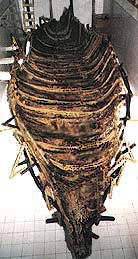
A friend of mine uses a boat analogy when talking with Mormons about salvation. An individual's good works are the planks of wood that make up the hull of the boat (salvation). Latter-day Saints believe the grace of God given through Christ is the pitch that fills in the cracks between the planks, making the boat safe and seaworthy. But there's a problem here.

Take a look at how God describes natural man in Romans 1:
"They were filled with all manner of unrighteousness, evil, covetousness, malice. They are full of envy, murder, strife, deceit, maliciousness. They are gossips, slanderers, haters of God, insolent, haughty, boastful, inventors of evil, disobedient to parents, foolish, faithless, heartless, ruthless." (Romans 1:29-31)

You see, the sin debt for each of us is enormous! Six-billion dollars. Two-hundred-thousand years' worth of labor.

Some might say, "Well, we have eternity to work it off. We can do it if we just have enough time." Sorry, folks. The master in Jesus' parable is already entitled to all the labor his servant can provide. The debt owed is above and beyond normal labor. It is impossible to pay.

And what makes us think that anything we do would be pleasing and acceptable to God anyway? Look again at the qualities He finds in us! How can our sin-tainted good works be used to build a sound boat? In my friend's analogy the truth is that the planks of the boat are all rotten. There's nothing there firm enough to be patched by God's grace. Instead of floating on the water this boat sinks like a stone—and takes anyone relying on it to the bottom of the sea.

No, there's nothing we can contribute to the building of our boat. Like the servant in Jesus' parable, our only hope is grace and mercy. God must provide both the planks and the pitch. And He does. Thanks be to God for His indescribable gift!

Labels: , , , , ,